HOA Insights: Common Sense for Common Areas
We exist to help all 2 million volunteer HOA Boardmembers nationwide have the right information at the right time to make the right decisions for the future of their community association. Stay with us weekly for actionable insights that minimize stress, avoid catastrophes, and protect property values!
Watch On Youtube
Shop!
HOA insights now has its very own merch store! Our team has whipped up some hats, mugs, T-Shirts, & more that we think Volunteer HOA Boardmembers are gonna love. We also offer dozens of FREE zoom backgrounds. Available in our Boardmember Merch Store!
Support Our Sponsors
Association Insights & Marketplace
Association Reserves
Community Financials
Kevin Davis Insurance Services
Stoke Light Video & Marketing
The Inspectors of Election
HOA Insights: Common Sense for Common Areas
177 | How Much an HOA Loan Really Costs Your Owners?!
Use Left/Right to seek, Home/End to jump to start or end. Hold shift to jump forward or backward.
A $250,000 roof project can cost owners much more with an HOA loan. See how borrowing changes the final bill.
✅ Is a Reserve Study right for you? 👉 https://www.reservestudy.com/
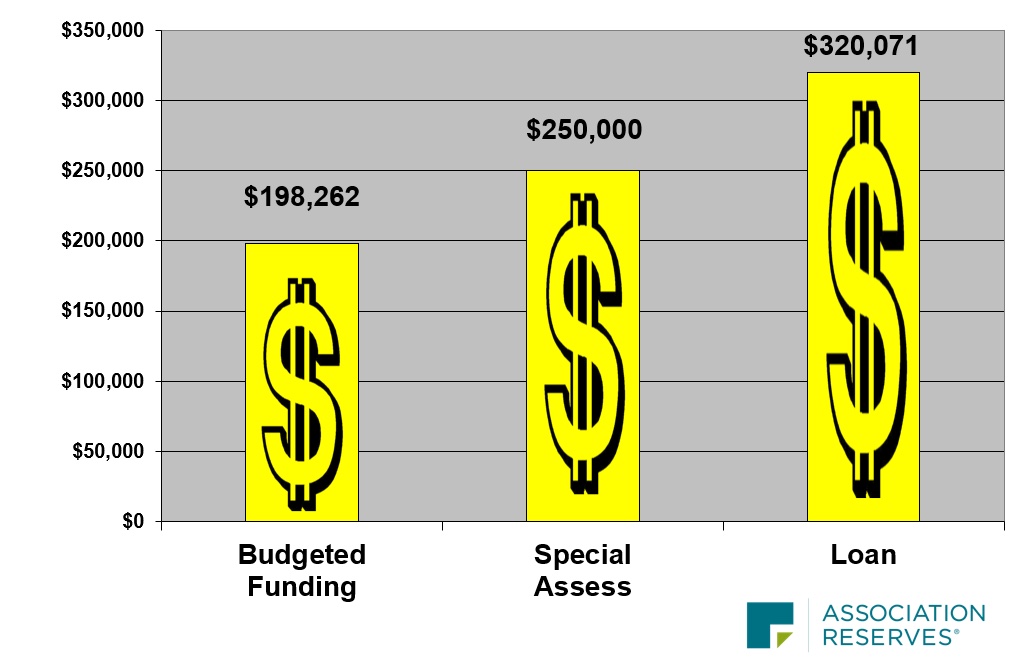
📊 Robert's Cost Comparison 👉 http://www.reservestudy.com/wp-content/uploads/2026/09/Ep-177-Infographic.jpg
In Episode 177, Robert & Julie take a closer look at what an HOA loan can really cost homeowners. This time, they put actual numbers behind the decision and compare the financial impact of borrowing with special assessments and funding projects through reserves. Using a $250,000 roof project as an example, Robert and Julie show how interest and loan costs can significantly increase what owners ultimately pay. They also discuss why planning and funding earlier can give boards more options and help prevent an expensive loan from becoming the only solution when a major repair can no longer wait.
Chapters:
00:00 How much does an HOA Loan really cost your owners?
03:27 Why do HOAs end up needing loans or Special Assessments?
05:58 Why isn’t getting an HOA Loan guaranteed?
07:08 How does an HOA actually pay back a loan?
09:20 Why can hybrid funding plans get complicated for homeowners
11:56 Should HOAs offer different Special Assessment payment options?
12:48 When should boards start planning for major repair costs?
14:30 Can your Reserve Study help phase major projects?
16:15 What changes when a bank becomes part of your financial plan?
18:51 Ad Break - Kevin Davis Insurance Services
19:20 What does a $250,000 roof really cost under each funding option?
22:44 Why does Funding Reserves early matter so much?
26:11 How early should boards communicate major assessment increases?
28:46 Can committee members help build homeowner trust?
29:32 Why should HOAs start funding future projects now?
30:36 How can boards make difficult funding decisions easier?
Podcast Links:
Full Episode List
Watch On Youtube
Engage in the conversation!
Call our 24/7 voicemail line at (805) 203-3130 or send an email or voice memo to podcast@reservestudy.com
Nominate yourself or a Board Hero you Know!
Board Hero Nominations
Boardmember Merch Store!
Connect with Hosts on LinkedIn
Julie Adamen
Kevin Davis, CIRMS
Robert Nordlund, PE
Support Our Sponsors
Association Insights & Marketplace
Association Reserves
Community Financials
Kevin Davis Insurance Services
Stoke Light Video & Marketing
The Inspectors of Election
If you have committee members out there, use them. They can be your boots on the ground to talk to everybody. Your landscape committee is always out and about. The architectural committee is always out and about. And if you bring them in, you know, talk to the board. The board tells them everything that's going on. You bring those people on board first, or maybe some of your more involved homeowners involved in clubs or whatever, they may not be a committee member. Bring them in. Utilize them as your foot soldiers, because the more of you that are out there, that are saying positive things, and yes, this is the answer to this, the better it
Announcer:is. HOA Insights is brought to you by five companies
that care about board members:Association Insights and Marketplace, Association Reserves, Community Financials, Kevin Davis Insurance Services, and the Inspectors of Election. You'll find links to their website and social media in the show notes.
Robert Nordlund:Hi, I'm Robert Nordland of Association Reserves,
Julie Adamen:and I'm Julie Adamen with Adam and Inc. And this is HOA Insights, where we promote common sense
Robert Nordlund:for common areas. Well, welcome to episode 177, where I'm again speaking with management and leadership consultant Julie Adamen of Adaman Inc. We're following up on Julie's episode number 168 with Rolf Crocker, where they discussed navigating forward, looking at special assessment and loan options. We're going to do a dive into that subject again today, actually comparing the numbers so you can get an idea of how much each one actually costs your homeowners. Well, we're here weekly, so if you missed last week's episode 176 with board member and attorney Roger Minch, you missed some wise counsel on when to spend the money and get an attorney involved in something at your association. And if you don't have an attorney on your team. Roger also gave some advice on how to select an attorney to join your leadership team. If you missed that episode or any other prior episode, take a moment after today's program to listen from our podcast website, hoainsights.org, or search for HOA Insights on YouTube. But better yet, subscribe from any of the major podcast platforms, or subscribe to our podcast's YouTube channel, so you don't miss any future episodes, and so the podcast increases in the search rankings and becomes more findable to more board members. And of course, if you like what you hear, spread the word. There are about 2 million board members out there, and we want to help as many as we can, bringing common sense to their common areas nationwide. Well, those of you watching on YouTube can see the HOA Insights mug that I have, Julie, in the dishwasher,
Julie Adamen:dishwasher. Sorry,
Robert Nordlund:that we got from the merch store, which you can browse through from our HOA Insights.org website or the link in the show notes, or you can visit simply to pick up some great free stuff there, like board member Zoom backgrounds to use for your next board meeting. Well, we enjoy hearing from you responding to the issues you're facing at your association. So if you have a hot topic, a crazy story, or a question you'd like us to address, keep in touch at 805-203-3130. We listen to all those messages, or email us at podcast at hoa insights.org. Well, today's program is a follow up to episode 168, as I said a moment ago, on special assessments versus bank loan choices, and this time we're going to talk about the numbers. So, Julie, to start off, can you summarize what you and Rolf covered?
Julie Adamen:No, no. Okay, well, make sure that also was there. That's right. Bye, everybody. That was a while ago. It was. It was a while ago. A lot of things have happened between now and then. But in essence, what Rolf Crocker owns Omni Community management in the Sacramento area of California, and he and I have known each other for years and years. We speak together a lot, and so I asked him, "Let's talk about this. I said, "Okay, and we really just riffed on it. But I'll tell you, see, Rolf has the information from the management company aspect, which means in the trenches with the board members and trying to get these the problem of not having enough funds on hand to do a major repair or replacement, whether it is caused by a natural disaster or whether it is just wear and tear. Typically, it's more of the wear and tear type thing, and the board that is now dealing with it is the only board that's going to has dealt with anything in the last 10 years. That's usually what happens. They're they're the ones you know in musical chairs you know how when the music stops they're the ones left standing so they try to do something about it and our conversation was wide ranging but what we really came out with was first how you're going to decide what you're going to do obviously council is should be involved in that type of thing and how many associations do more of a hybrid than anything else right now because I think I don't want to give away the part of the you know the the big part of the story here, but only about 50% of HOAs who apply for a loan get a loan. Now it used to be higher back in the olden days, so I would say 10 to 15. Years ago, and it's there's there's myriad reasons why it isn't that way anymore. That now you only have half a chance of getting in there, 50% chance of getting it. So people will often either get a lower loan, which they may qualify for, and then do a special assessment. How to enact the special assessment? How to commute? My big part, and Rolf has Rolf got had more of the nuts and bolts. My big part was about how are you going to sell this to the homeowners. Yeah, I mean, and you know you need it. You're the board members. You have the fiduciary duty to make sure this happens. But how do you bring the others along with you? And it's it's no small task, and it's not going to take like one email or one town hall and an email. It's usually more than that. So anyway, that's really what we talked about. And if you guys haven't seen it, please go back and look at it. Ralph is a fountain of information as far as this type of thing goes. Been around the industry almost as long as Robert and I. I think he's like three years less than than me. And so Robert and I are right at the same time. So yeah,
Robert Nordlund:couple less laps around the sun. Julie, I would I I enjoyed listening. I enjoy this podcast even as a listener, and I enjoy I enjoyed hearing you guys talk through that and what you said just right then that every association is subject to deterioration. Not every association is subject to like a natural disaster, and so every association needs to be aware of this situation because these big bills are coming. And my notes about this were: identify how you got into this situation, do your homework, make sure you have a good understanding of the problem, and build trust. And that's all that communication. But boy, it was sobering to learn when we were speaking to the bankers in a prior episode, episode 155, and they were talking about getting a loan is not a sure thing. So I think there's so many associations out there, like you say, that think, oh, I could do A or B.
Unknown:Yeah,
Robert Nordlund:and you only got half a chance of getting B, and so you're pushed into some uncomfortable space. But it's just it's crazy,
Julie Adamen:you know, Robert. That you just said a really salient thing. It's an uncomfortable space because it's not black or white. All of a sudden, you're in this gray area that you have to do something of both, and that in itself, I mean, even if, as a board member, you're volunteer, obviously you get paid so well, but you're not making any money doing this, and this is definitely going to take more of your time and energy and your emotional energy as well. So it's not, oh, we could just get a loan and then we have to pay that back. But how do you pay it back? Let's think that part through. How do you pay that back?
Robert Nordlund:Yeah, that's it. I think part of it is we've gotten so comfortable with credit in our society. We, I pay for so many things with my credit card. We get points, and those points get me on airplanes, and I get to, yeah, I get a lot of free airplane travel with my points. We pay it off each month, and for us it's a positive thing. But we are comfortable with credit not paying it at that time, and I think as a society we've gotten a little more comfortable that oh yeah I'll I'll just pay it off later
Julie Adamen:a little too comfortable
Robert Nordlund:a little maybe too comfortable now we most of us have mortgages we're comfortable with that, and I think there's still people getting comfortable with the fact that once they spend 500,000 or 200,000 or a million or 5 million or whatever they pay for their community association home, only the beginning of the expenses because that thing deteriorates, and they're like, "Jeez Louise, I bought this $500,000 condo, and it needs one. Raising the assessments, yeah, raising the assessments, or they're going to be a special assessment. I thought I bought it. It's not like buying a new car where you get to expect that. What's the first two year warranty or five year warranty or whatever? Yeah, where they're going to take care of it. Okay, I like the idea of the hybrid solution. So it's not an either or. There are going to be some people at the association that can just write a check. There may be some associations that want to provide a way for others to spread it out. There's a lot of good in between, so it's not just a A or B solution. But what were you going to say?
Julie Adamen:Even in the gray part there, yeah. So that was a really interesting thing I thought to think about because I haven't been an boots on the ground manager in a long time, but I'm around it all the time, obviously. So I thought this was super interesting, and I think a lot of boards who are looking at this problem. Okay, let's just say, for argument's sake, let's say that most associations who are actually going to qualify for some sort of a loan are also going to have to do a special assessment. So, everyone think this through. Okay, the special assessment everybody's got to pay. Again, as Robert said, some people are going to be able to just you know write a check or you know send put their credit card in and it's done for them. They don't think about it, but a lot of people can. They're going to have to make payments on that. Now, the other part of that is when an association gets a loan. Think this through: How do you pay that back? Well, you're going to have to raise assessments, even if it's for the next three or four years, which may as well be forever, to pay that back, so now you're in a situation where you have people who can just write the check. People are still in the working world, or they have you know enough financial wherewithal just to take care of that. But what do you do about the people who can afford to live in your community on a day-to-day basis? And as assessments go up, you know, three or 4% a year. We hope that's what you're all doing, but if they they can afford that, when all of a sudden you put on another well, you're going to have to pay $10,000 for the special assessment, and we're going to increase dues another. Let's just you know another 30% or 20% Let's just say 20% for argument's sake. 20% all in one year. So, as a board member, what are you going to do? It's a sticky wicket. You have to deal with it because you're fiduciaries. You absolutely have to for the betterment of the association as a whole, for the owners now and the owners in the future. So, what are you going to? Well, you're going to likely. You don't want to shove people out, you know, of their homes if they can make the payment over time. Okay, so you might have to have more than one type of payment plan. There may be people who can pay it off in six months. There may be people who can. Now I'm talking. I'm talking the special assess. Special assessment. You're
Robert Nordlund:talking hybrid, hybrid, hybrid hybrid. Do the special assessment and increase in assessments. You got special assessment. You have an increase in assessment, and you have a community association loan. And even in the special assessment, there may be some people who write the$10,000 check, and some people who say, "I need a year. Can I take a year?
Julie Adamen:And you may have to offer two or three different types to do that. Now, hopefully, if you are hopefully at this moment you're not self-managed, meaning the board is managing everything because this is going to make your your billing to the homeowners it might be three or four different or five different ways of doing this. Someone can pay it off in six months. Somebody else can pay it off in a year. So, or you may just say, well, if you pay it off in six months, that's great. We'll give you $100 off. You pay it off in a year, you don't get the $100 off. There's things you can do that way, but it has to be really well thought out. And I think this is just forewarned, is forearmed for board members who may be looking at this, maybe not this year, maybe not next year, but you know in the back of your mind that in 2029, you're going to have to do something because you know the chickens come home to roost that year. And if you know it, start thinking about it now. I would say number one, get counsel involved. You absolutely, this is a part of your duty to do. Talk to your banking institution, and and you may want to talk to more than one because there are ones that do just your stuff, and others that actually specialize in banking for HOAs, but they also do loans for HOAs. Not all banks will do that. It's very. I was talking to a guy. In fact, Chase. It was my J.P. Morgan, who was who's one of my bankers, and he's like, "Yeah, there's a lot of loans going out. I'm like, "Yeah, it's a it's a pretty if if they have the money, it's a pretty good gig for the banks. It's interesting because they're-I mean-they're so huge. This is probably peanuts to them. But for it's-it can be quite-it's quite a business because how many associations are in the country, Robert?
Robert Nordlund:Almost 400,000.
Julie Adamen:Almost 400,000. That's right. And the more and more are being built every year by the amount of how many a year is it? 30,000, 20,000 a year?
Robert Nordlund:I don't know, but it's a big chunk of all new housing.
Julie Adamen:It's a huge chunk of all new housing. Yeah,
Robert Nordlund:and every single one of those is getting older every year and facing bigger and bigger problems.
Julie Adamen:Absolutely, and all the ones that are in existence now. I mean, if you have to think about it, some of the oldest associations. I worked with one in Southern California. It was Leisure World Seal Beach, and that place was built in the early '60s. So I mean, they're a huge organization, but but I mean that's a lot of aged aged infrastructure and aging. So but and don't forget everybody. If you live in an older place, once you fix something, that clock just starts ticking again. These are all the the the balls you have to. I want you're not juggling balls. You're juggling chainsaws because they're going around. But you have to think of it that way.
Robert Nordlund:I like your idea. I'd add the reserve state provider to that also because they're the ones who see is that a hard gate for this big project, or how much squishiness do we have? What are our options? Can we phase it out? Can we spread it out over five years, or do we have to do it all at once? There may be some things like an elevator modernization that your reserve state provider may say you need you have four elevators, you need to modernize them, and that's a big number. Reality, you may only want to take two out of service at a time, or one out of service at a time, and spread it out so you've got functional elevators. So there's more than one way to skin a cat,
Julie Adamen:especially if you're talking about a community like like that Leisure World or any over 55. I mean, Leisure Worlds they skew even older than that, is my understanding. I think the average resident's in their 80s, and so you if you can't have half of the elevators out at any one time because they all need them.
Robert Nordlund:Everyone needs an elevator. Yeah, that's a life safety thing.
Julie Adamen:It is a life safety thing, and it's convenience and life safety for sure. These are other things to take it. I'm just pointing that out as a thing to take in consideration as a board because if you're in good health and you're in your mid 50s or mid 60s, and you don't mind going up and down the stairs. You can't forget those homeowners that that can't. So you do the best you can for everybody at once. And it's I don't envy you. I'm as some of you know already. I'm I'm currently running for the board place I live in, and we have that issue here. Though we don't have any. I mean, we're all single family homes. We don't have elevators or anything like that, but we have a whole lot of amenities. So as people get into their 80s, what can, what can't they do? What are we going to have to provide? I mean, they're doing this already, but there's all levels of service going on due to the age of the populace.
Robert Nordlund:I want to introduce one subject before we take a break, and it reminds me of my conversation with Roger Mitch on the last episode, and he was talking about developing a team for your association board member as an inner circle team, and then the professionals that support them as the the planets that orbit around the landscaper, the attorney, the accountant, the tax preparer, the reserve study provider, the insurance broker, all the the people that the board needs to make wise decisions. They need to be able to reach out to those person and get wise counsel. And it it just strikes me that the banker, a lot of people kind of don't care about it. They may not know where their money is. They give the money to the management company. The management company puts it in the bank. They push the reserves over into a savings account, and they may not really care. But when you have a loan, the banker sits at your table, and they are going to be the one that says,"I'm sorry, but no, you can't do that, or I'm sorry, but you must do that. And they're the ones talking about saying, okay, I'll give you this $1 million loan, but you must raise your assessments by 30% or in real numbers, $150. That's just crazy. I think a lot of boards don't appreciate that you add another seat at the board member table when you get a loan, because if the banker is going to stick their neck out with that kind of a chunk of money, they are going to be involved in what's going on, and we'll talk about it again after the break. But they're going to dictate terms because they're the money. It's their money, and they say they're going to want to be paid back. You alluded to it earlier. Used to be most association loan requests got approved because bankers saying it's an association. Where is it going to go? You know they've got a pretty permanent income stream. Now we're dealing with older associations that have bumps in the road, projects, ownership that is tired, maybe got used to those $375 a month monthly assessments, and are gonna rebel. What do we say? Torches and pitchforks when it goes up. So just be careful about that. So let's take a quick break at this time to hear from one of our generous sponsors. After which we'll be back with more common sense for common areas and looking at actually the numbers on the difference between loans, special assessments, and ongoing funding. See you in a couple of moments.
Kevin Davis:Hi, I'm Kevin Davis, the president of Kevin Davis Insurance Services. Our experienced team of underwriters will help you when you get that declination. We provide the voice of reason, someone who will stand by you. Our underwriters bring years of knowledge to our clients that can't be automated by technology or driven by price. As a proud Enwind company, we bring true value to your community association clients. We are your community association insurance experts,
Robert Nordlund:and we're back. Thank you for joining us here, Julie. And I had a good conversation during the break. We promised getting to numbers, and so we want to get to the numbers. I've got a page from a PowerPoint here, and I'll try to get that into the show notes. is from a webinar that we prepared just recently, and the bottom line is, there's an amazing difference in the cost to your homeowners when you're choosing between ongoing payments, part of budgeted assessments, special assessment, or a loan. And let me just read you these numbers. If you've got a 250,000. Roof project, that's a 15-year life roof. So we're not even saying that you're going to collect interest over a long time, just 15 years. If you're putting in interest at 3% interest, which is current rates now, your homeowners will be putting in about $198,000 for that $250,000 loan. How do you get to 250? Well, the bank puts their money in, and I love having the banker as your silent partner outside, paying you money. I love that. I love my clients paying $198,000 for a $250,000 roof. That's cool. Special assessment last minute. You say, "Gee, we need$250,000, and over 100 units, that's $2,500 a piece. They wince, they get out the checkbooks, and we talked about hybrids or hybrids and time and lots of stuff, but it's going to cost each unit owner $2,500 at that association. Now, if you get a loan at current terms, a seven-year loan, 7% interest with the points at the beginning of it, paying that out over seven years will be $320,000. And so, you're talking about your owners Paying $320,000 for a $250,000 roof, and those are big numbers. So again, as we spoke about early in the program, a loan is not a sure thing. It's not just you know we could do A or B or C. I think you have to appreciate how expensive of an option a loan is, and I spoke before the break about how the banker is now sitting in your board as that sixth person on a group of five people. If you had to raise your assessments 100 bucks a month to because the banker said you need to about yeah you're doing it because you need you need that million dollar loan because the roofs are going to leak, and you can't pass that big of a special assessment, or whatever the the reasons are, about $70 of that 100 is going to go to your roof. About $30 of that 100 is going to go to the banker, and that's just crazy to think. And the roof doesn't care. The roof just needs to get replaced. It's they're tired. The roof needs to get replaced. They're done keeping rain and moisture out of your buildings. If you really care about your homeowners, you're going to put that 50 or$70 into the bank starting now, so you don't get into that jam in the future with the banker taking their big chunk out of whatever you're setting aside into reserves. Am I characterizing that pretty well, Julie?
Julie Adamen:Absolutely, I think, and it's it's it sounds scary. I mean, and and it is, and it can be. But the point is so well taken for you board members out there who know this isn't coming up on you right now. But you look at your reserves, and they're 30% funded, 25% funded, and you may be thinking, and I understand it. Well, I'm not going to be on the board in 10 years, so I don't care. Well, yeah, if you're still living there, you're going to care because you're going to pay. Number one, but number two, I just want to remind everybody that you are trustees, you are fiduciaries, and it's not just for now; it's for into the future. So, if the decisions you're making now should positively affect the community as a whole in now and into the future, so you say,"Well, it's not positive to raise assessments now. Well, yeah, it is. You can't be myopic about it. You have to look at the big. In fact, this is your whole job as a board member. You're you're on the you're you're at the top of the Titanic looking for the iceberg. You're not down underneath, you know, at the number four piston making sure it works. So you want to be able to see that iceberg coming and move off in the other direction. Believe me, everybody, I get it. You're volunteers. You don't get paid for this. It's a big job. It's much bigger than you ever thought it would be. But you signed up for it, and here we are. I it's it's our turn as board members to be the adults in the room. So I I just think your point is extremely well taken, and everybody needs to take that to heart. If you can mitigate something that's going you know you can see coming down the pike in 10 years, maybe even seven. You should start doing something now.
Robert Nordlund:I really like that idea. You said that you may not be a board member, but you're still going to be a homeowner. When I think back, I think I'm the house that we live in. I still think of that as our new house, but I think if I check the dates, I think it's six or seven years now. Days go into months, go into years, and you may be on the board a few more terms, and you may have given yourself a heck of a problem. And like you say, if you're not on the board, pretty fair chance you'll still be a homeowner, and you'll get that special assessment letter from the board. And you have the opportunity now, to for 2017 to increase your budget and put more into reserves because those costs aren't going away.
Julie Adamen:2027, Robert. 2027.
Robert Nordlund:What did I say?
Julie Adamen:2017. Boy, they do go fast, don't they? Yeah, we're getting old here, people. This
Robert Nordlund:is recording. Yeah, you made your own
Julie Adamen:point. He made the point. He's right. I made my
Robert Nordlund:own point. Yeah, take the steps there because it's going to be good for you. It's going to be good for the association. And not only is 100% of that money going to go to reserves, which goes to the roof, that silent banker is going to add their 3% compounding, and so that whatever money you put in is going to be that $20 you put in is going to grow to 25. It's going to grow to 27. It's fantastic. But Julie, we spoke about hybrids and hybrids and confronting this and being a fiduciary. The element that I caught from your conversation with Rolf was so much about getting the homeowners on board. So, talk to me about the communication years in advance. What are the honestly?
Julie Adamen:Yes, I would. If you can, I would start at least a year in advance if you have that opportunity. And I think one of the biggest problems that happens between boards and homeowners is that boards have all this knowledge, and then all of a sudden they're like, "Okay, we have to do this now. We got an loan, blah blah blah. And the homeowners like, "What? And that creates that's an unforced error on the part of boards. Boards, if you have that opportunity again, like we said, in in a year, two years ahead of time, but even if you have to start three or four months ahead of time, transparency is absolutely everything. That means email communication. That means town halls. That means possibly individual board members holding just conversations in you know in the clubhouse or in. I mean, here we have a clubhouse, restaurants, everything, and so you know we can just go to one of the restaurants, say I'm going to be there. I'll answer as many questions as I can. Yes, is it a big fat pain? Yes, is it something you may not be comfortable with potentially? But I bet there's a couple board members who would be, and so you guys can take on different roles to do this. But there is no such thing as too much communication here. None, none, none. You can over communicate in what you want to do. So, how would you how would you make them feel comfortable and feel like they're in good hands? That's your goal. Make the homeowners more. You're always going to have the dissenters. Your job is to mitigate the number of dissenters because, as you know, a more happy populace is much easier to be a board member over or with. The unhappy, if if 40% are really unhappy. You're going to hear a lot about it. If 12 or 15% you're going to hear, but it's not quite so bad. And then you have that whole other group of people saying, "Well, I I went to this town hall and I really understood what they were saying. And one more thing, I'll use because I know we need to land the plane. But for board members, don't forget if you have committee members out there, use them. They can be your boots on the ground to talk to everybody. Your landscape committee is always out and about. The architectural committee is always out and about. And if you bring them in, you know, talk to the board. The board tells them everything that's going on. You bring those people on board first, or maybe some of your more involved homeowners involved in clubs or whatever. They may not be a committee member. Bring them in. Utilize them as your foot soldiers, because the more of you that are out there, that are saying positive things, and yes, this is the answer to this, the better it is. In the community I live in, the two groups that what I that you need to bring in here would be pickleball and golf. Pickleball's bigger than golf now. If you can get a the pickleball committee and the golf group in on board, you can do really, really well.
Robert Nordlund:I think I want to just add two things to that. One is, you said use the committee members. I don't mean use them badly, but see them as your ambassadors. They, you as a board member, may have a stain on you because of something that happened two years ago, and they may dislike you, but your committee members may be the effective ambassadors that you can use to communicate that. Oh yeah, well we'd like to do that, but you know, forefront in everyone's mind is the roof project in three years, which is probably why our assessments are going to go up next year. They they can say those little things that all of a sudden people start to think and they realize, oh g. And that's my second point is that you want you talked about starting early on the communication. I want to encourage start early on the funding. If you can raise your assessments 20 bucks a year this year with all of it going to reserves, so raising your reserve funding 20 bucks a month that multiplies over the years, and that's going to make all your future problems get significantly smaller.
Julie Adamen:And communicate that as well. Exactly what you're saying. Why are we raising dues? Well, we're doing it to put them directly into reserves. We'll show you all, and it's because of this.
Robert Nordlund:Yeah, and we expect that if we start putting it in now. By then, we will grow our reserves by 50 grand, preparing us for the roof, and we'll get this much interest off it. And it's going to make our any future special assessment smaller. Whatever it is, start now because those costs aren't going anywhere. Julie, thank you. We want to wrestle with this. It's important. We want people to not create their own problems, and see the reality of the costs around them, and understand all these decision points that come with owning a piece of real estate that is under a constant state of deterioration. Any closing thoughts to add at this time?
Julie Adamen:No, not really. Well, yes, of course, Robert. I always have some thoughts that need to be said. Have you met me? I guess. I guess it would be that as board members, you know, I think we sometimes feel like we're put upon. I mean, because we are. I mean, it's there's a lot on your shoulders, but you know, there are ways to mitigate how to to make sure things go as smoothly as possible, just like any other business. The problem is we're all not getting paid to do this. But you, if you look at what you're going to get back in the own value of your home, and and the value of your friend's home, your entire community's homes by being able to fund the reserves appropriately, take care of things as they come up, as you're able to, and if you're not able to do that, you're going to look at all the different ways to solve the problem. Get the advice you need from your general counsel, from management if you have management, from your from your experts. Your team could be your insurance agent. You can talk to your reserve study specialist, and gosh, a lot of these people-not the lawyer, but a lot of people-just come in and talk to you free of charge because they want you to do the right thing. So utilize your resources, communicate early and often, try and start earlier than you can. Yes, the burden is heavy. I know you all feel like Sisyphus. You know you're you're pushing that rock uphill, just the boulder, just right uphill, and it always comes back and rolls on you. Kind of true, but you know, if you do it the way we're talking about it, have forethought and and communicate with your people. Do it as transparently as possible. One of these days, you're going to push it right up and over that cliff, and you'll be able to sit down and have a cocktail.
Robert Nordlund:Yep, I hope that we have given some associations, some ideas, and so that when that roof project, or that asphalt project, or that painting project gets done without a special assessment, they have a twinkle in their eye because yeah, we we got this done right, and our owners are on board, our property values are great, the two bedrooms are now selling for X amount, which is more than last year. Those are things, and we want to be part of that solution. Julie, this is fantastic. Wonderful time. Yeah, this is good. We hope you learned some HOA insights from our discussion today that helps you bring common sense to your common areas. Thank you for joining us. We look forward to bringing many more episodes to you week after week after week. We'll be here, and it'll be great to have you and other board members you know join us on a regular basis. Spread the word. Thank you very much.
Announcer:You've been listening to HOA Insights: Common Sense for Common Areas. If you like the show and want to support the work that we do, you can do so in a number of ways. The most important thing that you can do is engage in the conversation. Leave a question in the comments section on our YouTube videos. You can also email your questions or voice memos to podcast@reservestudy.com, or leave us a voicemail at 805-203-3130. If you gain any insights from the show, please do us a huge favor by sharing the show with other board members that you know. You can also support us by supporting the brands that sponsor this program. The opinions expressed in this program are for general information purposes only and are not intended to provide specific advice or recommendations for any individual or on any specific security, it is only intended to provide education about the financial industry. To determine which investments may be appropriate for you, consult your financial advisor prior to investing. Any past performance discussed during this program is no guarantee of future results. Any indices referenced for comparison are unmanaged and cannot be invested into directly. As always, please remember investing involves risk and possible loss of principal capital. Please seek advice from a licensed professional. Capital CS Group LLC is a registered investment advisor. Advisory services are only offered to clients or prospective clients where Capital CS Group LLC and its representatives are properly licensed or exempt from licensure, no advice may be rendered by Capital CS Group LLC unless a client service agreement is in place. Finally, this podcast was expertly mixed and mastered by Stokelight Video and Marketing. With Stokelight on your team, you'll reach more customers with marketing expertise that inspires action. See the show.
Unknown:To connect with Stoke Lake.

%20v2jpg.jpg)